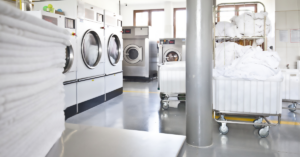
Healthcare laundry must be carefully managed, hygienic and comply with strict standards to protect patients, support clinical staff and prevent the spread of infection.
This article explores:
- The options hospitals have for laundry management
- The challenges faced by hospitals and central laundries
- The regulations every provider must meet
- How WASHCO can help: The technology that supports safe and systematic operations.
Terminology at a glance:
- Central laundry: The main location where healthcare laundry is processed. Usually, an outsourced, off-site facility.
- Hospital laundry: Includes bedsheets, patient gowns, towels, privacy curtains, and healthcare worker uniforms (scrubs, doctors’ coats, nurses’ outfits).
- Linen turnover: How quickly linens such as bedsheets and pillowcases are used and replaced.
- Soiled linen: Used linen that may contain bodily fluids or waste matter. Requires specialist handling.
- Regulatory compliance: Following health, safety, and hygiene requirements set by organisations such as the NHS in the UK.
- Infection control: Processes designed to prevent the spread of infectious diseases within healthcare settings.
- Hospital-acquired Infections (HAIs): Infections patients contract as a result of receiving care in a healthcare facility.
Hospital laundry models: central laundry vs ward-end OPL
Hospitals typically use one of two main laundry models or a combination of both.
Central (outsourced) laundry
Most hospitals outsource the bulk of their linen requirements, sending items such as bedding, gowns, towels, and uniforms to specialist commercial laundries equipped to handle high volumes at pace.
These facilities offer:
- Industrial-scale equipment
- Robust zoning between clean and dirty areas
- Specialist infection-control workflows
- Efficient, cost-controlled processing
WASHCO supports commercial laundries with high-performance equipment designed for healthcare environments, and also provides tailored solutions for smaller hospitals and sites operating on-premise laundry (OPL).
Ward-End (on-premise) laundry
Many hospitals also have smaller, on-site machines for tasks that need fast turnaround or tight infection-control oversight.
Examples include:
- Microfibre mops and cleaning fabrics
- Reusable cloths
- Patients’ personal clothing (e.g., in mental health wards)
WASHCO’s Little Giants and other compact systems are frequently installed in these areas, giving hospitals local control over smaller volumes while outsourcing the majority of linen to larger facilities.
A hybrid approach
In practice, most hospitals use both models, outsourcing high-volume textiles while managing specialist or high-frequency items on-site.
The challenges of healthcare laundry
Regardless of whether laundry is centralised, outsourced or handled on-site, hospitals face the same core challenges:
- Guaranteeing sanitised textiles are always available when needed
- Protecting patients and staff from infection (HAIs)
- Managing a wide variety of textile types
- Meeting strict budget and efficiency requirements
- Meeting ambitious net zero targets as per the NHS net zero plan
The constant threat of HAIs means healthcare laundry must go far beyond standard commercial practices.
Regulatory compliance — key UK requirements
Whatever model a healthcare facility uses, it must comply with stringent UK regulations throughout the laundry process.
Key standards include:
HTM 01-04 – decontamination of linen for health and social care
The UK’s primary guidance for processing healthcare linen. Covers zoning, infection control, equipment standards, wash parameters and staff training. Compliance supports patient safety and CQC approval.
Care Quality Commission (CQC)
The CQC inspects and regulates healthcare providers in England. It requires facilities to take measures to prevent infection and maintain cleanliness, including how linens are handled.
Health and safety at work etc. Act 1974
Requires employers to protect employee health and safety. For laundry teams, this includes safe handling of soiled linen and operating heavy equipment. Read more: Health and Safety at Work etc. Act 1974
Control of substances hazardous to health (COSHH)
Under COSHH, staff are protected from exposure to hazardous substances – such as soiled textiles and strong detergents. Requires PPE, training and correct chemical use.
Manual Handling Operations Regulations 1992
Laundry staff frequently lift, carry and move heavy loads. Risk assessments and safe lifting practices (under these regulations) are important to protect staff from injury.
Water Supply (Water Fittings) Regulations 1999
Laundry equipment must include ‘backflow’ prevention – to protect the clean water supply from contamination as per the Water Fittings Regulations.
Environment Agency regulations
Covers the safe disposal of wastewater, detergents, pathogens, organic matter and microfibres. Find out more
ISO and British standards for healthcare laundry
Relevant ISO and British Standards
ISO 9001 / ISO 14001 – Quality and environmental management
BS EN 14065 – Risk analysis and biocontamination control
ISO 13485 – Where laundry includes reusable medical devices such as surgical drapes
ISO 13485 – Medical Device Laundry Compliance
How modern healthcare laundries operate: an overview
While processes vary between facilities, central and on-site laundries share the same goal: to make sure every textile is processed safely, hygienically and systematically – at pace.
Most healthcare laundries follow these principles:
- Strict separation of clean and dirty zones: Often supported by one-way routes, hygiene locks and controlled airflow.
- Barrier or tunnel washing: To prevent cross-contamination and ensure reliable disinfection.
- Careful sorting and handling: Using colour-coded, leak-proof bags and appropriate PPE.
- Quality assurance checks: Including visual inspections and, in some cases, microbiological testing.
- Equipment maintenance: So machines consistently reach the required temperatures, dosing accuracy and hygiene standards.
WASHCO’s equipment and control systems are designed to support these environments, helping laundries maintain compliance and operational reliability.
Water and energy conservation in central laundries
Sustainability is a growing focus for healthcare laundries, especially as the NHS moves toward its Net Zero by 2040 targets.
WASHCO helps healthcare providers meet their environmental objectives:
- Energy- and water-efficient equipment helps reduce Scope 1 emissions by lowering on-site energy and resource consumption
- WASHCO’s commitment to sustainability contributes to customers’ Scope 3 emissions reduction goals
Auto-weighing (load-sensing) systems
Machines automatically detect the weight of each load and adjust water levels, chemical dosing and cycle settings. This means only the necessary resources are used, cutting the amount of water used and operating costs while maintaining wash quality.
Moisture-control systems for faster drying
The cycle stops as soon as textiles reach the correct dryness level. Intelligent moisture sensing prevents over-drying, protects fabrics and significantly reduces energy use.
These innovations help hospitals meet environmental goals while ensuring reliable and compliant linen processing.
WASHCO’s expertise in healthcare laundry
Microfibre mop washing – case example
WASHCO helped Brighton & Sussex University Hospitals NHS Trust bring microfibre processing back in-house by designing and supplying two on-site laundry facilities.
Outcome: Each laundry thermally disinfects 39kg of mops per hour for fast, hygienic turnaround.
What WASHCO offers healthcare customers
Consultation & needs assessment: Understanding each facility’s requirements to design the right solution on a case-by-case basis.
Tailored equipment solutions: Systems designed specifically for healthcare textiles, including mops, cloths and patient garments.
Installation, maintenance & support: End-to-end service to keep laundry operations running smoothly and efficiently.
Training & compliance guidance: Helping staff follow best practice and meet key regulatory requirements.
WASHCO is an approved supplier on recognised procurement frameworks.
Contact WASHCO on 08000 546 546 or info@washco.co.uk
Our experts will help you design a compliant, cost-effective solution.
FAQs about healthcare laundry
What are industrial ‘barrier’ washers?
‘Industrial barrier’ washers are washing machines where the dirty laundry is loaded on one side and clean, sanitised laundry is unloaded from the other – creating a physical barrier between the two loading and unloading points. These are important in environments like hospital laundries where preventing cross-contamination is critical.
What are ‘tunnel’ washers?
Tunnel washers (or ‘continuous batch washers’) are industrial washing machines that carry out multiple stages of the cleaning process. Once loaded into the tunnel washers, items are cleaned, rinsed and dried. All without leaving the machine.
This keeps the linen moving through specialised cycles for infection control. It also saves time – taking away the need to load and unload at different stages.
What is a ‘hygiene lock’?
A controlled transition zone between clean and dirty areas, helping prevent airborne or physical transfer of contamination.