
Key takeaways at a glance:
If you run a commercial laundry, planned preventative maintenance (PPM) is the foundation of safe, reliable and cost-effective operations. From legal compliance to equipment longevity, this guide covers everything you need to know about PPM services and how to get them right.
Navigation guide
- What is planned preventative maintenance (PPM)?
- PPM: what the law requires
- Who should carry out maintenance work?
- Types of maintenance: a practical overview
- PPM at work: care home laundry example
- The role of commercial planned preventative maintenance providers
- IoT and the future of planned preventative maintenance services
- Final thoughts
- FAQs: heat pump vs vented tumble dryers
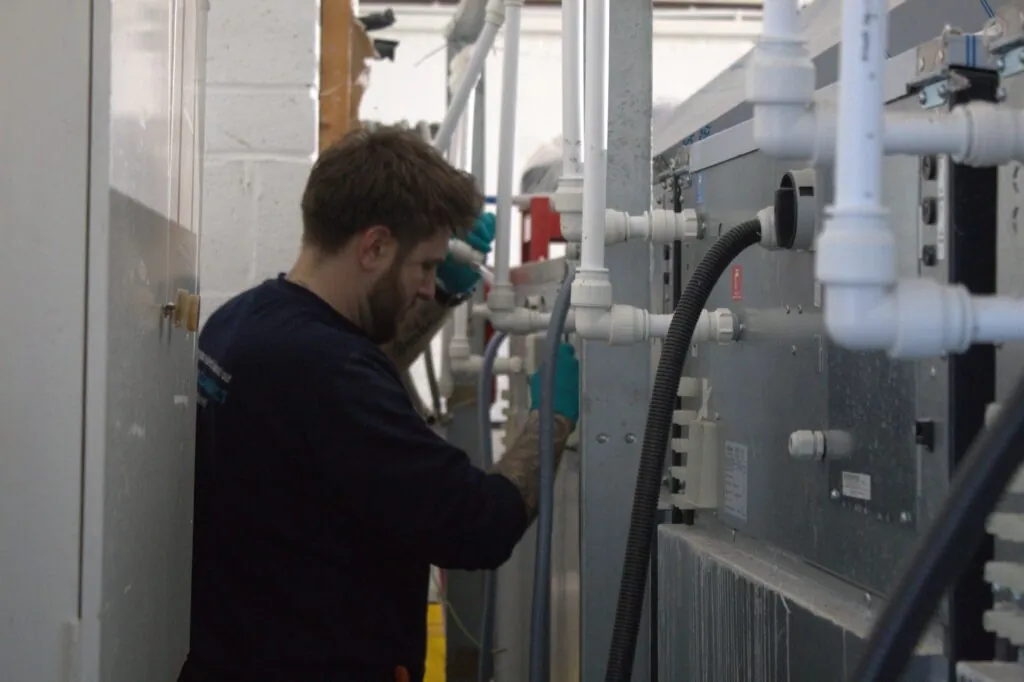
- Planned preventative maintenance (PPM) is a proactive, scheduled programme designed to prevent equipment failures before they occur.
- The more you use your machines, the sooner they’ll need a PPM service. It’s not just a ‘once-a-year’ tickbox.
- Gas appliances must be inspected by a Gas Safe registered engineer at least once every 12 months, and electrical equipment must be regularly maintained in line with HSE guidelines.
- Alongside professional PPM engineer visits, the people who actually use the machines every day (your staff) need to do their own regular cleaning and checks.
- Failing to maintain your equipment can void warranties, invalidate insurance claims and put staff and residents at risk.
- IoT-connected machines can now proactively alert you and your service provider when maintenance is due, transforming reactive repair into smart prevention.
- Partnering with a qualified PPM provider ensures expert technicians, genuine parts and full regulatory compliance.
What is planned preventative maintenance (PPM)?
PPM means carrying out scheduled checks, part replacements and inspections before a fault turns into a breakdown. In commercial laundry, it keeps your washing machines and equipment running safely, efficiently and compliantly.
Unlike reactive maintenance (waiting for something to go wrong), planned preventative maintenance puts you in control. Identify worn components, clear lint from dryer ducts, and verify electrical and gas safety on a regular basis to reduce the risk of unexpected downtime or costly emergency repairs.
A common misconception? PPM only needs to happen once a year. In reality, it comes down to how many cycles your machines complete. A high-volume care home laundry may need PPM visits more often than a lower-use setting, for example.
PPM: what the law requires
Gas equipment
According to the Health and Safety Executive (HSE), all gas appliances should be inspected for safety at least once every 12 months by a Gas Safe registered engineer.
Failing to arrange this inspection risks equipment damage, structural harm to your building and most critically, danger to the people in your care.
Electrical equipment
It’s legally required to keep electrical equipment maintained in a way that prevents danger. The specific user checks, inspection intervals and testing requirements vary depending on the type of equipment, where it is used and the findings of previous inspections.
Not carrying out the mandatory maintenance in good time can:
- Void your equipment warranty
- Result in unsuccessful insurance claims
- And even compromise the safety of the people using your laundry
Who should carry out maintenance work?
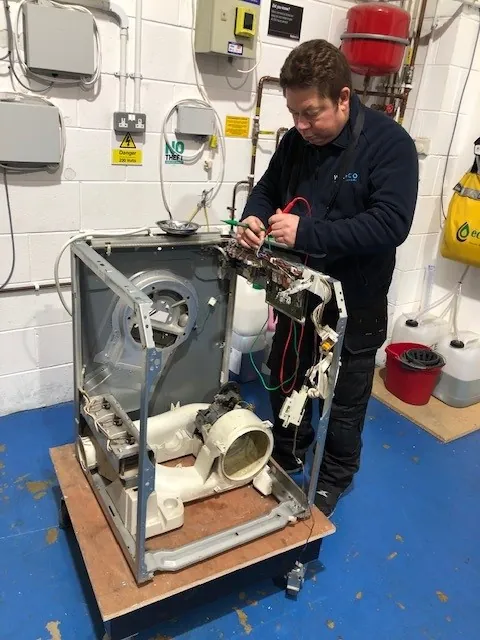
Not all maintenance tasks require a specialist engineer. Some routine activities (such as cleaning a tumble dryer lint filter after each cycle) can be safely carried out by trained operators. However, the keyword here is trained: anyone performing equipment checks should receive proper instruction on correct procedures, safety hazards and who to contact if they spot a problem they cannot fix themselves. More advanced technical tasks, including annual gas servicing, should be left for the professionals.
All maintenance personnel (in-house or contracted) should wear personal protective equipment (PPE) at all times.
Types of maintenance: a practical overview
Regular cleaning and user checks
Operators can clean and perform checks on a daily, weekly, monthly or annual basis, as detailed in each machine’s manufacturer’s manual. These routine tasks are a critical first line of defence against breakdowns and accidents, and they directly extend the machine’s lifespan.
Key user-level tasks include:
- Cleaning dryer lint filters after every use – lint build-up is a significant fire hazard and also makes drying cycles less efficient.
- Running a high-temperature maintenance wash on commercial washing machines at least once a month to prevent detergent residue, biofilm, odours or drainage issues.
- Monitoring for warning signs such as unusually long drying times, contents that are extremely hot after a cycle or unexpected machine shutdowns – all of which can indicate a blocked vent and an elevated fire risk.
- Reporting any abnormalities to a qualified technician or your service provider right away.
Sometimes lint builds up in areas that are hard to reach, like inside dryer venting systems. This is one reason planned preventative maintenance services are so important: trained technicians can inspect and clear these areas as part of a scheduled PPM visit.
Planned preventative maintenance (PPM)
A planned preventative maintenance programme goes beyond day-to-day user checks. It’s a comprehensive schedule of technical servicing carried out by qualified engineers, typically covering:
- Assessment of component condition and identification of wear
- Inspection and clearance of dryer ducts and lint build-up in hard-to-reach areas
- Electrical safety checks
- Replacement of parts before they fail
- Performance testing and calibration
“Miele recommends servicing your machine regularly to ensure it continues to deliver consistently good cleaning results, limits downtime and preserves the value of your investment. Routine servicing, combined with a planned preventative maintenance (PPM) schedule based on usage, helps ensure optimal performance and longevity.” – Miele Professional GB & Ireland
Extraordinary (reactive) maintenance
Even the best-maintained equipment can occasionally break down. When a fault or malfunction occurs, contact your service provider for diagnostics and repair.
Don’t overlook the supporting infrastructure either. Water supply lines, drainage and ducting all play a role in machine performance and should be well-maintained.
PPM at work: care home laundry example
To make this concrete, here’s a planned preventative maintenance example for a care home operating commercial washing machines and tumble dryers across multiple loads per day:
| Frequency | Task | Who |
| After every cycle | Clean the lint filter | Trained operator |
| Daily | Inspect the machine for visible damage or error codes | Trained operator |
| Monthly | Run a high-temperature maintenance wash | Trained operator |
| Per manufacturer cycle count | Full PPM inspection (components, ducts, electrics) | Qualified PPM engineer |
| Annually (minimum) | Gas safety inspection | Gas Safe registered engineer |
| As needed | Reactive repair for faults or breakdowns | Qualified service engineer |
The role of commercial planned preventative maintenance providers
For care and nursing homes in particular, consistent laundry provision is non-negotiable – it underpins infection control and resident wellbeing.
A specialist commercial PPM provider plays a central role in keeping operations running via:
Scheduled preventive maintenance
Expert technicians
Genuine parts
Emergency support
Cost-effective plans
Compliance assurance
IoT and the future of planned preventative maintenance services
Managing maintenance across a large number of machines can be complex. But technology makes it easier. Internet of Things (IoT) connectivity enables smart commercial laundry equipment to monitor its own performance in real time and send automatic alerts when servicing is approaching or a fault is detected.
This transforms PPM from a scheduled diary entry into a dynamic, data-driven process. Service providers can access real-time and historical data remotely, dispatching engineers with the right parts before a breakdown even occurs. That means: reduced downtime, faster resolutions and greater confidence in your compliance.
“At Grandimpianti, we proactively manage maintenance, safety and reliability thanks to the IoT. Real-time and historical data usage are crucial to achieving these goals. Once the appliances are connected, it’s like having full-time service always available to users… It’s all about better efficiency.” – Gabriele Giotto, Sales and Product Manager, Grandimpianti
Final thoughts
Don’t wait for things to go wrong. Rigorous, regular PPM protects your equipment, your people and your organisation.
Remember that planned preventative maintenance schedules are primarily driven by usage cycles. High-volume settings might need servicing more than once a year.
Failure to maintain your equipment can void warranties, compromise insurance cover and put the safety of staff and residents at risk.
Contact WASHCO’s Service team to learn more about our laundry servicing.
FAQs: PPM in laundry
What is planned preventative maintenance (PPM)?
How often should PPM be carried out?
Is planned preventative maintenance a legal requirement?
What is a planned preventative maintenance example for a commercial laundry?
A typical planned preventative maintenance example schedule would include:
- Daily lint filter cleaning by trained operators
- Monthly high-temperature maintenance washes
- Formal PPM engineer visits, triggered by cycle-count thresholds
- At the PPM visit, a qualified technician inspects components for wear, clears any lint build-up in internal ducting, carries out electrical safety checks and replaces any parts showing signs of deterioration
What happens if I don’t have planned preventative maintenance done?
Neglecting PPM can mean: equipment breakdowns and costly emergency repairs, voiding of manufacturer warranties, unsuccessful insurance claims, and non-compliance with HSE gas and electrical safety regulations. Also, in the worst cases, fire or electrical hazards. Consistent PPM is the best way to avoid these outcomes.